


Lesson 8) Beyond Neptune
4.8: Beyond Neptune
The Kuiper Belt
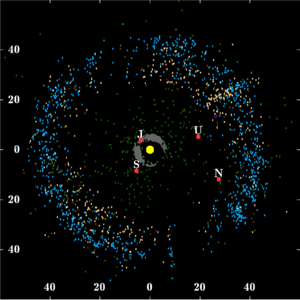
The Kuiper Belt
Source: here
Well, here we are at the Kuiper Belt, which you can now see. It was named after the astronomer Gerard Kuiper, who did research about objects beyond Pluto. The Kuiper belt is a ring centred on the Sun, extending from Neptune’s orbit (about 30 Astronomical Units (A.U.)) to about 50 A.U. Like the asteroid belt, it consists of small bodies, but these bodies are composed mainly of ices - that is, frozen water, ammonia, and methane - as well as rock. The following coloured dots are relevant to our discussion today: the blue dots that represent Kuiper belt objects, the orange dots that represent objects in the scattered disc (consisting of other small bodies, mainly short-period comets, with highly eccentric orbits), and the big red dots that are the four outer planets. The numbers are the distance from the Sun in A.U. The Kuiper belt contains three of the five confirmed dwarf planets (Pluto, Makemake and Haumea); Ceres is in the asteroid belt and Eris is in the scattered disc, a region of the solar system that extends from the outer edge of the Kuiper belt to 1,000 A.U. from the Sun.
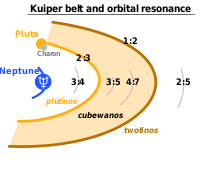
Neptune’s gravity has forced many of the Kuiper belt objects into resonances (two astronomical objects are in orbital resonance if the ratio of their orbital periods is the quotient of two small whole numbers). For example, Pluto is in 2:3 resonance with Neptune, meaning that it orbits the Sun twice in the time that Neptune orbits the Sun three times. The objects that are in 2:3 resonance with Neptune are called plutinos. Below is a picture of the location of the objects that are in resonance with Neptune. The source of this picture is the same as for the first picture.
This region was explored up close by the spacecraft New Horizons. Launched on January 19, 2006, it flew by Pluto on July 14, 2015 and took close-up shots of Pluto and its satellites. It continued to discover and photograph other Kuiper belt objects, including a body whose nickname was Ultima Thule, which is about 44 A.U. from the Sun. From ground-based observations it was once thought to be a single elongated body, but close-up images revealed that it is really two bodies held together by mutual gravitation, as we can now see. It has since been renamed Arrokoth, which means “sky” in the Native American Powhatan/Algonquin language.
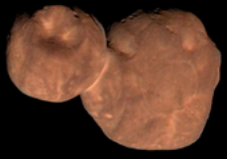
Arrokoth (same source as the first two pictures)
Pluto (Re)visited
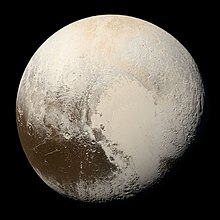
True-colour picture of Pluto
Source: here
And now we’re passing by Pluto, the first Kuiper Belt object that was observed from Earth. Pluto’s mean radius is 0.187 times that of the Earth, its density is 1.854 times that of water and its surface gravity is 0.063 times that of Earth. It revolves around the Sun in 248 Earth years in an orbit whose aphelion (greatest distance from the Sun) is 49.305 A.U., whose perihelion (least distance from the Sun) is 29.658 A.U. and whose inclination from the Earth’s orbit is 17.16 degrees. Although at perihelion it is closer to the Sun than Neptune is (29.81 A.U.), it never collides with Neptune. It rotates once every 6.39 Earth days with an axial tilt of 120 degrees – sideways and a bit backwards. Its angular diameter ranges from 0.06 arcseconds to 0.11 arcseconds and its apparent magnitude ranges from 13.65 to 16.3. Its optical and magical albedo are both about 0.72, which is much greater than that of Uranus and Neptune (about 0.3). Pluto’s rocky surface is covered with ice made of frozen nitrogen, which reflects solar magic before the rock could absorb it. The New Horizons spacecraft provided us with high-resolution images of Pluto’s surface (see the image below). You can clearly see blocks of ice crust and fragments of rocky terrain.
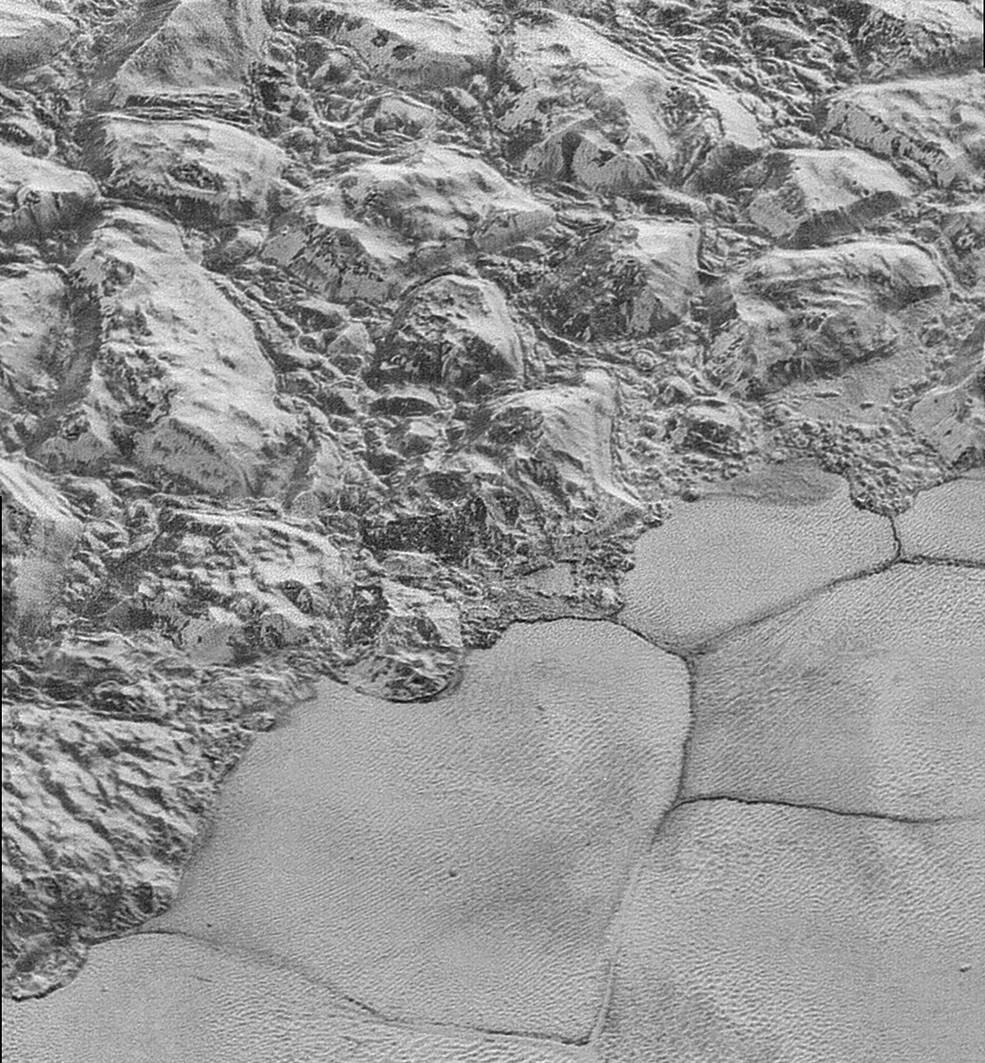
Pluto captured by NASA’s New Horizons spacecraft
Source: here
Even at perihelion, Pluto appears about 250 times fainter than Neptune and its A.M.E. Quotient is also about 1/250th of Neptune’s. In fact, there are about two million stars that appear brighter than Pluto, not to mention many of the other planets’ moons and some of the asteroids, so it is way down in the list of celestial bodies in terms of its magical influence on the Earth. Yet, Firenze assured us that it does have some magical effect, especially when it is aligned with the Sun. How could that be possible? Do you recall the Weber-Fechner law? It implies that each time you double the strength of a stimulus, you only add the same amount to your perception of it. As a result, you can perceive very weak stimuli without being overwhelmed by much stronger ones. For example, the loudest sound that doesn’t hurt your ears is a trillion times as strong as the softest sound you can hear. Similarly, you can feel Pluto’s magic when it is at perihelion and aligned with the Sun, whereas the Sun’s magic, when tamed, doesn’t overwhelm you even though it is about a hundred trillion times as strong as Pluto’s.
Eris
Let’s go now through the outermost region of the Kuiper belt and beyond and visit the last dwarf planet on our journey. Eris, which is roughly the size of Pluto, has a highly eccentric orbit that lies in the scattered disc region. Its perihelion is about 38 A.U. from the Sun, which is within the Kuiper belt, but its aphelion is about 98 A.U. away, which is far beyond that region. The day on Eris is around the same as a day on Earth, but a year lasts approximately 557 Earth years. Eris was discovered in 2005 by astronomy professor Mike Brown. You can see a 3D model of Eris here. We still don’t know much about this object’s surface features or characteristics, only that it is extremely cold on the surface of this dwarf planet. This fact shows us how many unknown things wait for us to discover and puts our knowledge of space in perspective.
The Oort cloud and the Light-Year
We leave Pluto and the other Kuiper belt objects on our imaginary journey away from the Sun. Beyond the Kuiper belt is a theoretically proposed cloud of objects called the Oort cloud, consisting of trillions of long-period comets, some of which, like the Hale-Bopp comet, get pushed by the gravity of passing stars into elliptical orbits that come closer to the Sun. Why is it only theoretically proposed? The comets are too small and too far away from the Earth and the Sun to be seen; their location was deduced by calculating the orbits of the comets that came close enough to be seen.
It is composed of two regions, the doughnut-shaped inner Oort cloud, also called the Hills cloud, whose distance from the Sun ranges from about 2,000 A.U. to about 20,000 A.U., and the spherical outer Oort cloud, whose distance from the Sun ranges from about 20,000 A.U. to about 50,000 A.U.; some astronomers say that the outer edge is farther away than that, though. Any objects much farther from the Sun than the outer edge of the Oort cloud wouldn’t orbit the Sun because the combined gravity of the other stars wouldn’t let them.
Voyager 1 recently exited the solar system at a distance of about 100 A.U. It’s moving away from the Sun faster than any other spacecraft, but it will take about 300 years to reach the Oort cloud, so it won’t be able to send back any data because it will have run out of power long before then.
The region between the Kuiper belt and the Oort cloud isn’t entirely empty. Sedna, a candidate for dwarf planet, is about 86 A.U. from the Sun. Despite how far away it is, Sedna is not the farthest known solar system body from the Sun; that record was held by a body appropriately named Farout (124 A.U. from the Sun) until it was beaten by another one, named Farfarout (132 A.U.). That’s the current record for observed objects. I wonder whether another word “far” will be added to the beginning of the name of each new object that breaks the record!
The nearest star, Proxima Centauri, is about 4.5 times as far from the Sun as the outer edge of the Oort Cloud is. Such distances are too great to be measured in A.U.. Instead, a bigger unit of distance is used: a light-year, which was defined by the International Astronomical Union as the distance that light travels in a vacuum in one Julian year (365.25 days). That’s right – a light-year is a unit of distance, not a unit of time; so if you ever hear someone referring to something taking many light-years to happen, you’ll know that they are trying to make you think that they know more than they really do. In the image below you can see Hubble’s newest shot of Proxima Centauri.
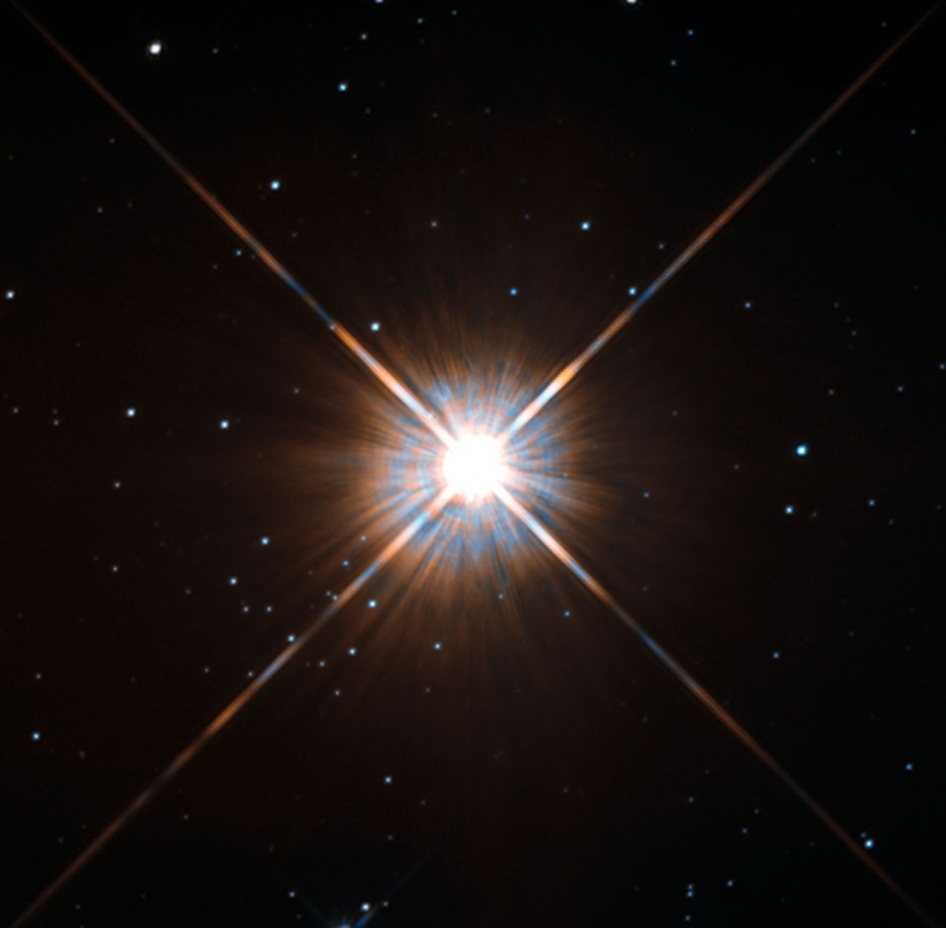
Proxima Centauri
Source: here
The speed of light in a vacuum is 299,792.458 kilometres per second; so a light-year is 9,460,730,472,580.800 kilometres, or about 5.88 trillion miles, or about 63,241 A.U.. The outer edge of the Oort cloud is almost a light-year from the Sun, whereas Proxima Centauri is about 4.244 light-years away. Well, we’ve reached the outer edge of the Oort cloud, but we’re not going to go all the way to Proxima Centauri.
Concluding remarks
This concludes our imaginary tour of the solar system. I hope you all enjoyed it. I certainly did! In Year Five we will be discussing stars. But before that, you will be taking Lesson Nine of this year (the mystery lesson) and writing your final exam and an essay, in which I will send you on another voyage into space. This one will not require you to be a hero, but I’m sure you’ll find it interesting nevertheless. And before even that, you’ll be doing the usual ten-question quiz on this lesson. Class dismissed.
Astronomy 401 is about the solar system. Lesson 1, which is a historical overview about how the planets were discovered and named, has been published. So has Lesson 2, which is about Mercury. So has Lesson 3, which is about Venus. So has Lesson 4, which is about Mars. So has Lesson 5, which is about Jupiter. So has Lesson 6, which is about Saturn. So has Lesson 7, which is about Uranus and Neptune. So has Lesson 8, which is about objects beyond Neptune.
- ASTR-301
Enroll

