


Lesson 7) Uranus and Neptune
Uranus
Contrary to the opinion of some Muggles and at least one well-known wizard, the name of the planet is usually pronounced with the accent on the first syllable (YOO-ruh-nus). It was named after the Greek god of the sky, the father of Cronus (whose Roman name is Saturn) and grandfather of Zeus (whose Roman name is Jupiter).
Our imaginary spacecraft has already taken us near enough to Uranus that you can see it the way it was photographed by Voyager 2. As you can see, Uranus is pale blue-green in colour and almost featureless, unlike the previous planets we’ve discussed. The next stop on this leg of our imaginary voyage will be Neptune.
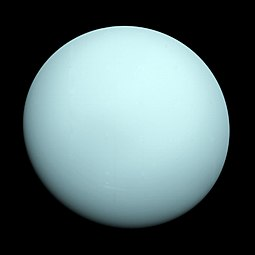
Uranus as seen by Voyager 2 in 1986
Source: here
Uranus can’t be seen without a telescope or at least binoculars unless you’re far from any source of light pollution. Its apparent magnitude varies from 5.38 to 6.03, which puts it near the limit of naked-eye visibility. It had been seen many times before its official discovery; the first definite sighting was made in 1690 by the astronomer John Flamsteed. But because it’s so dim and moves so slowly, it was thought to be a star. William Herschel, who is credited with discovering Uranus, was the first to see (in 1781) that it moved with respect to the stars. He originally thought it was a comet. However, other astronomers realised that it was a planet instead because they observed that it has no coma and moves in a nearly circular orbit. In 1783 Herschel acknowledged that they were right.
Planetary Motions
We now turn from Uranus’s discovery to its rotation and revolution about the Sun. It’s about 19.8 times as far as Earth from the Sun, it revolves around the Sun in about 84 Earth years, and it rotates about its axis in about 17.2 hours about an axis that’s inclined by 97.77 degrees from its orbit – sideways and a bit backwards!
The strange orientation of Uranus’s rotation axis produces some extreme seasonal effects. Starting at the height of northern summer, when the pole points closest to the Sun, an observer near that pole would find that the Sun would never set. Rather, it would move in a small circle in the sky around the planet’s northern celestial pole as the planet rotates. Over time, as Uranus moves along its orbit and its rotation axis points farther and farther from the Sun, the circle would gradually increase in size, with the Sun dipping slightly lower in the sky each day. Eventually, the Sun would begin to set and rise again in a daily cycle, and the nights would grow progressively longer with each passing day. Then, 21 Earth years after the summer solstice, the autumnal equinox would occur, with day and night each 8.5 hours long.
Days would continue to shorten, until one day the Sun would fail to rise at all. The following period of total darkness would be equal in length to the earlier period of constant daylight, plunging the northern hemisphere into the depths of winter. Eventually, the Sun would rise again; the days would lengthen through the vernal equinox and beyond, and in time the observer would again experience a long summer of uninterrupted (though very dim) sunshine.
From the point of view of an observer on the equator, by contrast, summer and winter would be almost equally cold seasons, with the Sun never rising far above the horizon. Spring and autumn would be the warmest times of year, with the Sun passing almost overhead each day.
Physical Characteristics
Uranus is about four times as big as Earth. Because of its rotation, its equator bulges. Its atmosphere is made up of gases and ices, more ices than the atmospheres of Jupiter or Saturn, which is why Uranus is called an ice giant as well as a gas giant. The gases are, by volume, 83% hydrogen, 15% helium, 2.3% methane (which gives it its blue-green colour) and traces of other gases, whereas the ices are ammonia, water, ammonium hydrosulphide and methane hydrate. Like the gas giants, it’s windy and cold, even colder than Saturn. Clouds form in the atmosphere but they’re not there all the time and they don’t cover the planet completely. Uranus has rings just like Jupiter and Saturn – thirteen of them have been discovered so far. They are made of particles that are darker and smaller than those that make up Saturn’s rings, so they don’t contribute to the planet’s albedo or apparent magnitude.
Uranus’s 13 rings are divided into two groups based on their distance from the planet: the inner rings and the outer rings. The inner rings - those that are closer to the planet - are very narrow and dark grey in colour. There are two outer rings - one is reddish and dusty and the other is blue. From the image below you can see the system of rings in colour.
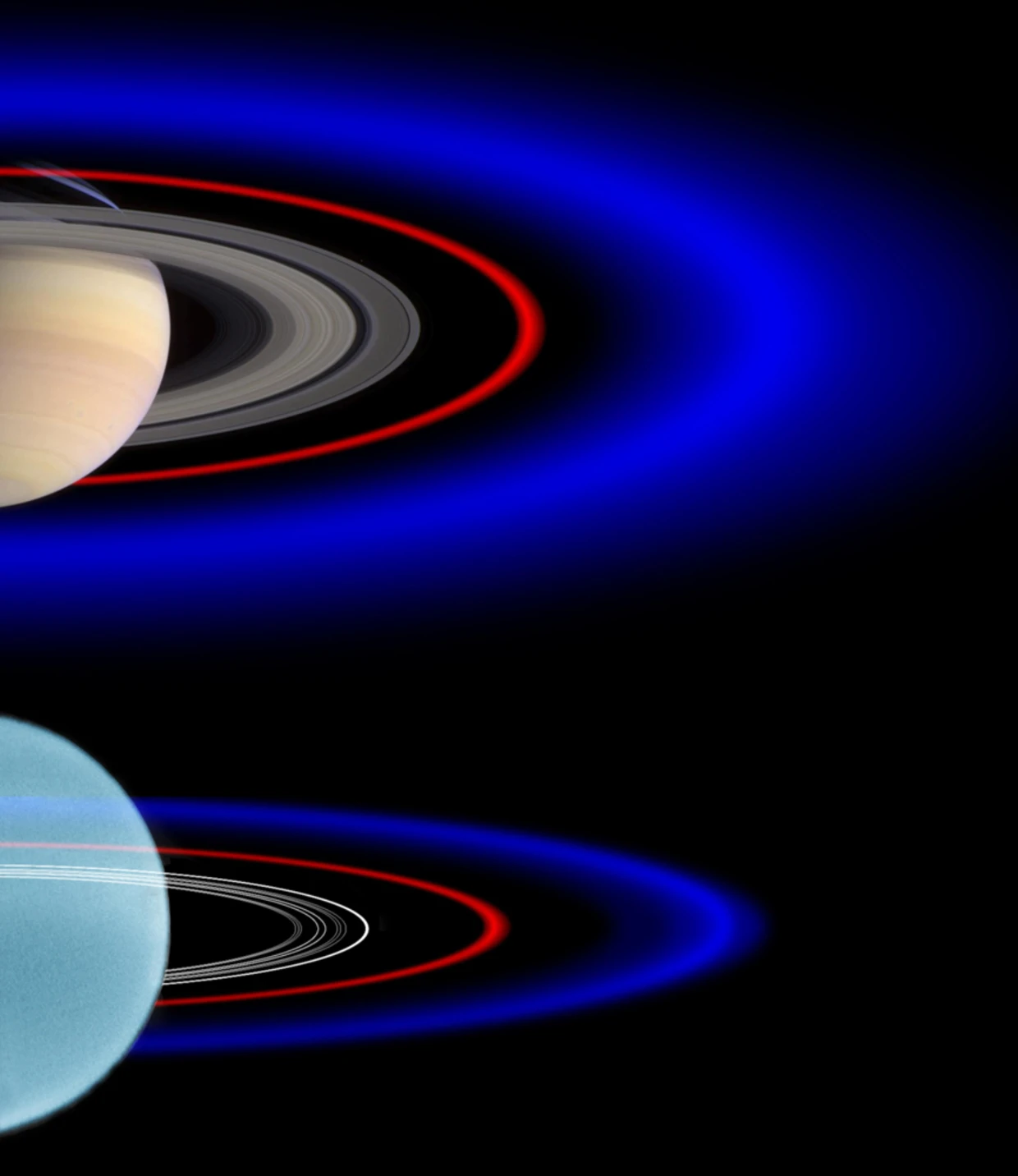
Uranus’s ring system
Source: here
Exploration
The only spacecraft to get close to Uranus is Voyager 2, a mission which might not have taken place. NASA hadn’t originally planned to explore Uranus and Neptune because the main mission was to get close to Saturn’s largest moon, Titan. If Voyager 1 had failed to get close to Saturn’s moon Titan, NASA had planned to send Voyager 2 to Titan to try again. Fortunately Voyager 1 succeeded in its mission, allowing NASA to send Voyager 2 to Uranus and Neptune. In addition to taking photos of the rings we knew of at the time, Voyager 2 made quite a few other discoveries: two new rings, ten more moons, and a magnetic field that is stronger than Saturn’s.
Angular Diameter, Albedo, Apparent Magnitude, and A.M.E.
Uranus’s angular diameter ranges from 3.3 arcseconds to 4.1 arcseconds. Its optical albedo is 0.300, and so is its magical albedo because the Sun’s magic gets reflected by the atmosphere rather than by stone, while its A.M.E. Quotient is much less than Saturn’s because it’s much dimmer. As you learned last week, Saturn’s apparent magnitude without the rings would be about +0.7 on average, whereas Uranus’s apparent magnitude is about +5.7 on average, about 100 times as faint. This makes Uranus’s base A.M.E. about 100 times less than Saturn’s. It is at its highest when it’s in conjunction with the Sun, so that’s when it makes its greatest contribution to the strengthening of Air Charms and your ability to get in touch with your own feelings.
Neptune
Here we are near Neptune. Neptune was named after the Roman god of the sea, whose Greek name is Poseidon. You may have seen its colour as deep blue, like the left circle in the picture below. That colour was artificially created from Voyager’s black-and-white photograph to enhance the planet’s surface features. Its true colour, the one on the right, is only a shade bluer than Uranus’s; nevertheless, Neptune has more visible features than Uranus.
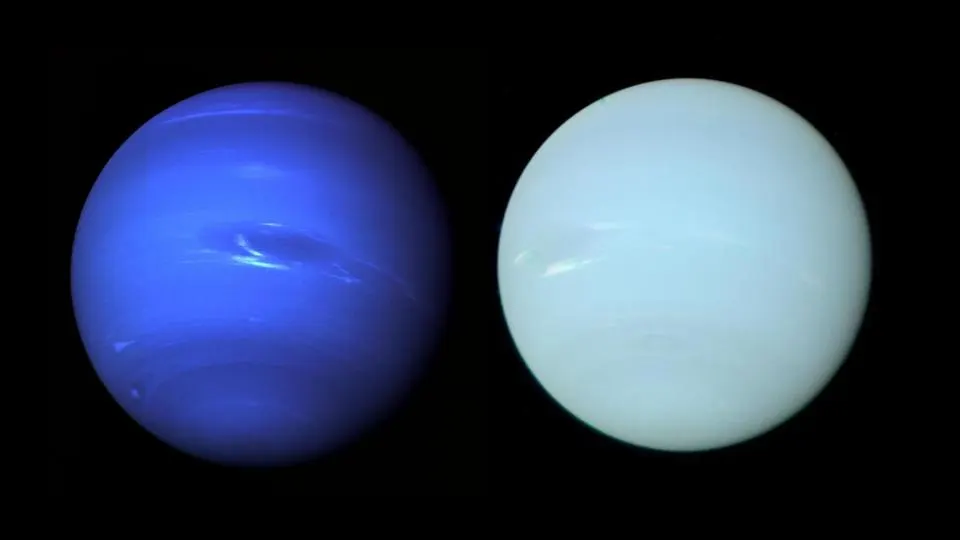
Neptune as created from Voyager 2’s black-and-white photograph (left)
and how it really looks (right)
Source: here
Although Galileo spotted and recorded it, he took it for a star, so he’s not the one who discovered it. The true discoverers were two other astronomers. In June of 1846, Urbain le Verrier saw that Uranus wasn’t where it should have been, concluded that a more distant planet’s gravity was pulling Uranus out of its predicted orbit, and calculated where that other planet ought to be. Then, on September 23, 1846, Johann Gottfried Galle found it within one degree of where le Verrier said it should be.
Planetary Motions and Physical Characteristics
Neptune is about 30 times as far as Earth is from the Sun, it revolves around the Sun once every 164.8 Earth years, it rotates about its axis once every 16 hours, 6 minutes and 36 seconds, and its axis is tilted 28.32 degrees from its orbit.
Neptune is very similar to Uranus, with a few minor differences. Neptune is about four times as big as the Earth, a bit smaller than Uranus but a bit more massive because it’s a little denser. Its atmosphere consists of 80% hydrogen, 19% helium, 1.5% methane and traces of other gases, and the ices are ammonia, water, ammonium hydrosulphide and maybe methane too. It has more ices than Jupiter or Saturn, so it too is called an ice giant as well as a gas giant. It’s even windier and colder there than near Uranus.
When astronomers first saw Neptune’s rings from the ground, they weren’t sure whether they really were rings because they are so faint and unstable that they appeared to have gaps. Their faintness is due to the fact that they are composed of smoke and dust rather than large, reflective blocks of ice. Their identity as rings, and the fact that there are three of them, were confirmed by Voyager 2. In the picture below, taken by Voyager 2, you can see the rings in detail.
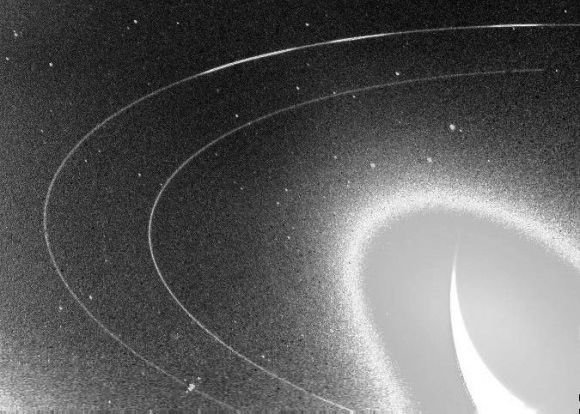
Neptune’s rings
Source: here
Exploration
In addition to the rings, Voyager 2 examined Neptune’s largest moon, Triton, up close. It discovered the planet’s weather system, found six more moons, and discovered that its mass is 0.5% less than previously calculated, disproving the theory that an undiscovered Planet X was acting on the orbits of Uranus and Neptune.
Angular Diameter, Albedo, Apparent Magnitude and A.M.E.
Neptune’s angular diameter ranges from 2.2 arcseconds to 2.4 arcseconds. Its optical albedo is 0.290, and its magical albedo is the same because the sunlight isn’t reflected from stone. Its apparent magnitude ranges from 7.67 to 8.00, so you can’t see it with your naked eye no matter how dark the sky is. Comparing its magnitude with that of Uranus, we can see that Neptune is about six times as faint, so its base A.M.E. Quotient is about six times as small. Still, it does have some influence on Earthly magic, especially when it’s in conjunction with the Sun, so that’s when it contributes most to the strengthening of Air Charms and the ability of Seers to make predictions. All other things being equal, if Neptune is in conjunction with the Sun, it is the best time for Seers to practise their divinatory skills.
Gravity Assist Used by Voyager 2
Voyager 2 used the gravity assist of Jupiter, Saturn, and Uranus to get to Neptune and beyond. The gains in speed it got were much more modest than what we got in our imaginary trip to Jupiter, but enough to enable the spacecraft to escape from the Sun’s gravity altogether, which it couldn’t have done otherwise. In the picture below, the spike at each planet represents the gain in speed on approaching the planet followed by the loss in speed on receding from the planet. Neptune actually slowed down the spacecraft a bit (that’s the price NASA was prepared to pay to send the spacecraft close to Triton), but not enough to keep it from reaching interstellar space.
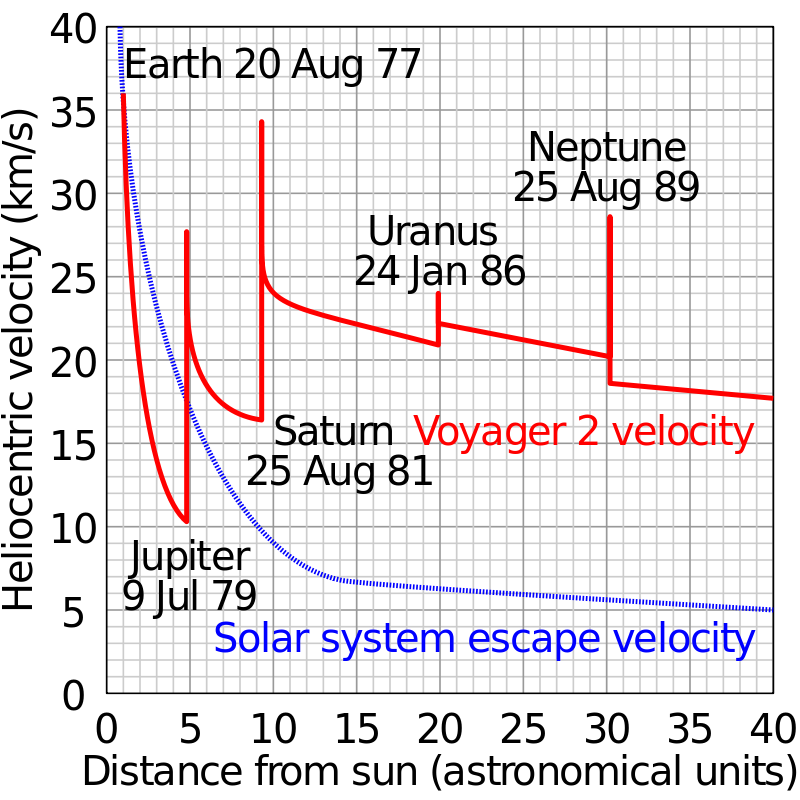
Gravity assist for Voyager 2
Source: here
Concluding Remarks
That concludes this leg of our imaginary voyage. The next, and last, one will take us to the Kuiper Belt, the home of the dwarf planets, and beyond. Meanwhile, there is some work to do for this lesson: no essay, but the usual ten-question quiz.
Some of this lesson was written by Professor Polgara.
Most of it was written by Professor Plumb.
Astronomy 401 is about the solar system. Lesson 1, which is a historical overview about how the planets were discovered and named, has been published. So has Lesson 2, which is about Mercury. So has Lesson 3, which is about Venus. So has Lesson 4, which is about Mars. So has Lesson 5, which is about Jupiter. So has Lesson 6, which is about Saturn. So has Lesson 7, which is about Uranus and Neptune. So has Lesson 8, which is about objects beyond Neptune.
- ASTR-301
Enroll


