

Lesson 6) Saturn
Please gather round as we approach another planet on our journey through the Solar System. Here we are, close enough to Saturn that we can see it the way the Cassini orbiter did in 2008.
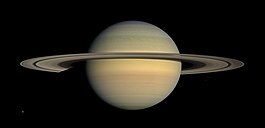
Saturn, pictured in natural colour approaching equinox, photographed by Cassini in July 2008; the dot in the bottom left corner is Titan.
Source: here
Saturn was named after the Roman god of agriculture. As you can see from the picture, Saturn’s surface bands are much fainter than Jupiter’s because colder temperatures on Saturn create a thicker, hazier upper atmosphere that obscures deeper, more colorful clouds. They are also wider at the equator because Saturn's equatorial jet stream is much faster and stronger and extends to higher latitudes. The polar regions are more interesting, though; there is a vortex at each pole. As we move closer to the planet, you’ll be able to see the vortex at the north pole the way Cassini saw it when it got close enough. Ah! There it is!
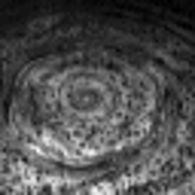
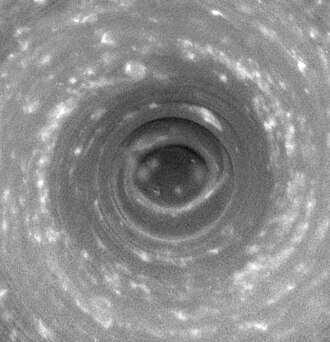
Saturn's north pole Saturn’s south pole
Another interesting fact about Saturn’s north pole is its unique shape. The six-sided jet stream resembles a hexagon. Cassini’s cameras captured the movement of “the hexagon” in colour. You can see how it looks in motion here. Muggles have conjectured about the cause of that shape, but they haven’t found it. Astronomers of the wizarding world theorise that it could be a magical analogue of the honeycombs created by bees to optimise the space they have available by creating round wax tubes and then pushing against them in order to maximise the available volume. The surface of Saturn may have certain zones with different amounts of magical pressure, and the high pressure areas push against their boundaries, while their centers are zones of lower pressure, like a hurricane or tornado would be. There could be many such cells in the vicinity of Saturn’s north pole, but the source of those rays is located at the north pole, which is why we only see one such area of high pressure.
And now we’ve circled Saturn, so you can see the south polar vortex. It’s warm, the only known example of such a phenomenon in the solar system. Muggles have explained the cause: it is heated by compression as the atmosphere above it sinks into it.
Planetary Motions
Saturn is about 9.5 times as far from the Sun as Earth is, it revolves around the Sun in approximately 29.5 Earth years, and it rotates around its axis in about 10.56 hours. That fact makes the days on Saturn the second-shortest days in the whole Solar System. Its equator and its rings are inclined at about 27 degrees from its orbit, so its axis too is tilted, which suggests that there are seasons on Saturn.
Physical Characteristics
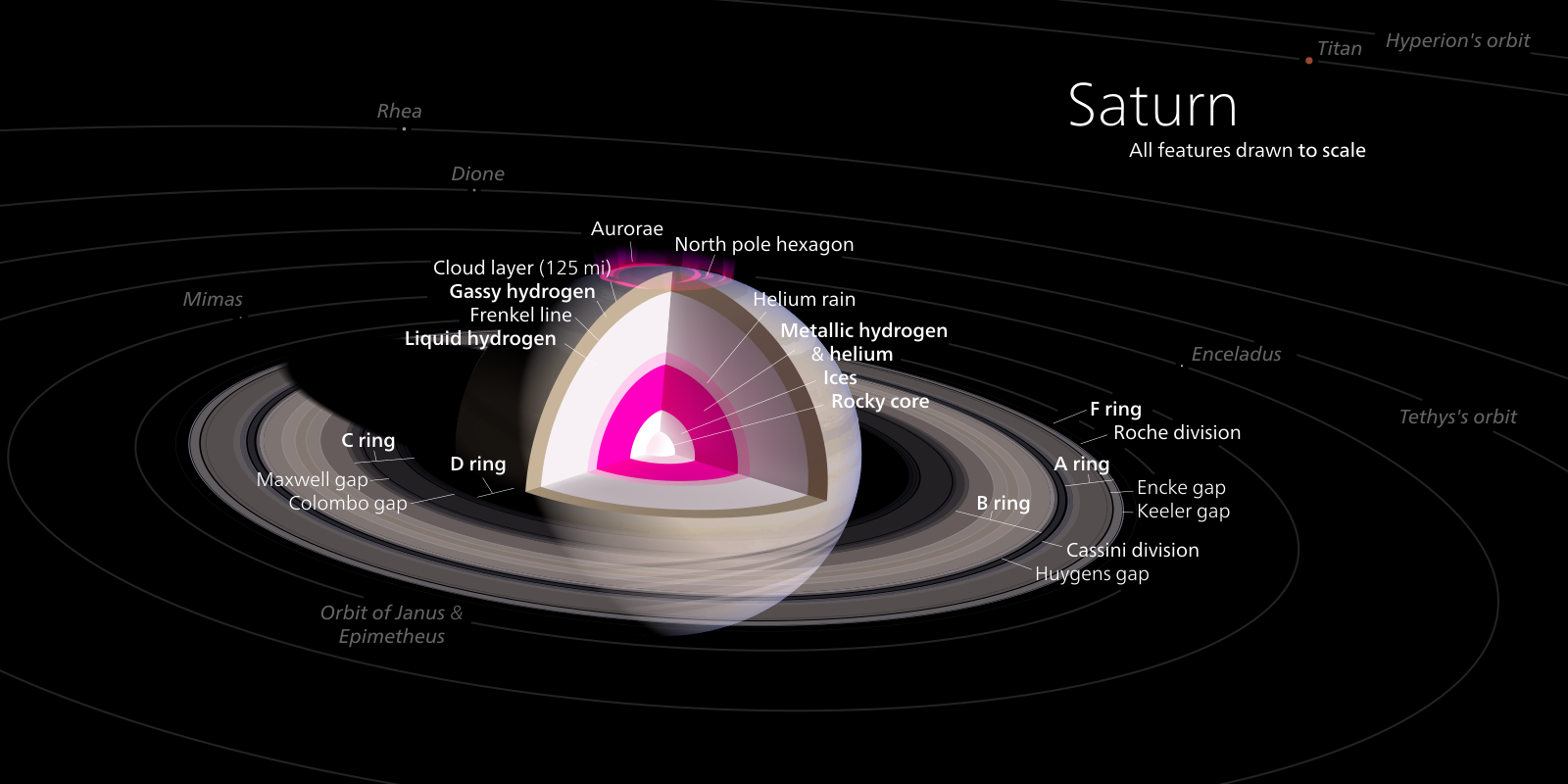
Like Jupiter, Saturn is flattened at the poles because of the centrifugal force caused by its rapid rotation. Its mass is approximately 95 times that of the Earth but its mean density is only 0.687 times that of water; so if it could be put in a big enough lake, it would float. Its magnetic field is a little weaker than Earth’s, so there’s no deadly radiation emanating from the planet. Its core is similar to Jupiter’s. A picture of Saturn showing its interior can be found here.
Saturn’s Rings
The rings surrounding this planet are made out of pieces of comets and asteroids that shattered due to Saturn’s strong gravity, from 60% to 90% of Earth’s surface gravity at the distance to the main ring system. These pieces consist of ice, rocks and dust, ranging in size from small grains to huge objects, some of them as large as buildings or even mountains. The system of rings spreads from the planet up to 175,000 miles (282,000 kilometres) and the gaps between rings are generally small, ranging from 3 or 4 km to 325 km (the Enke gap). There is one exception to this occurrence - a gap called the Cassini Division that measures 2,920 miles (4,700 kilometres).
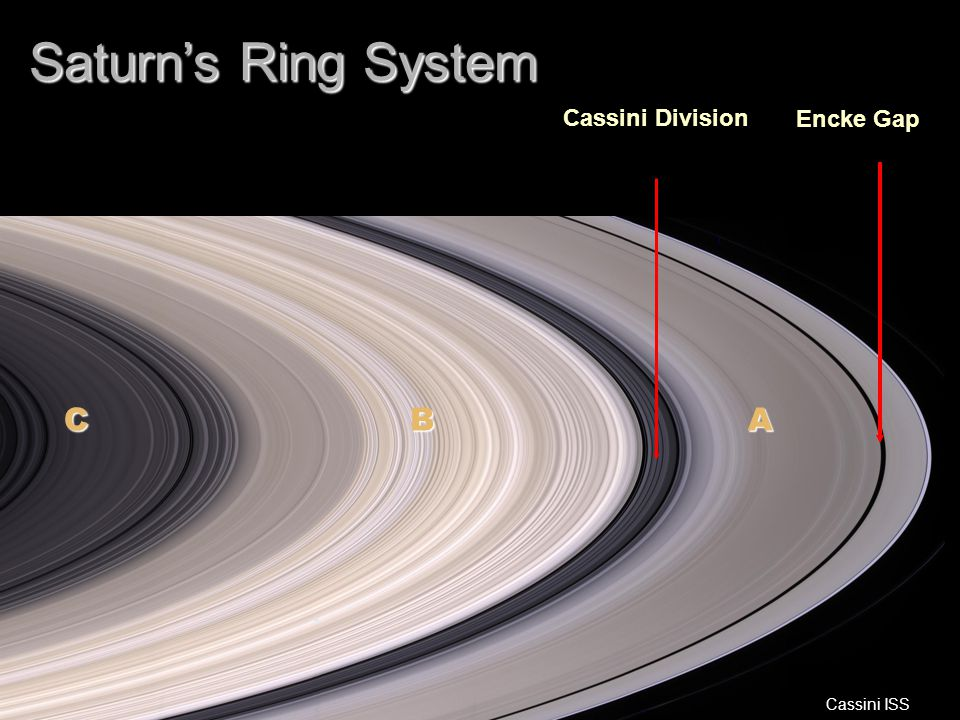
The Cassini Division
Source: here
The rings are named alphabetically in order in which they were discovered. Their order, from inner to outer, is D, C, B, A, F, G, E.
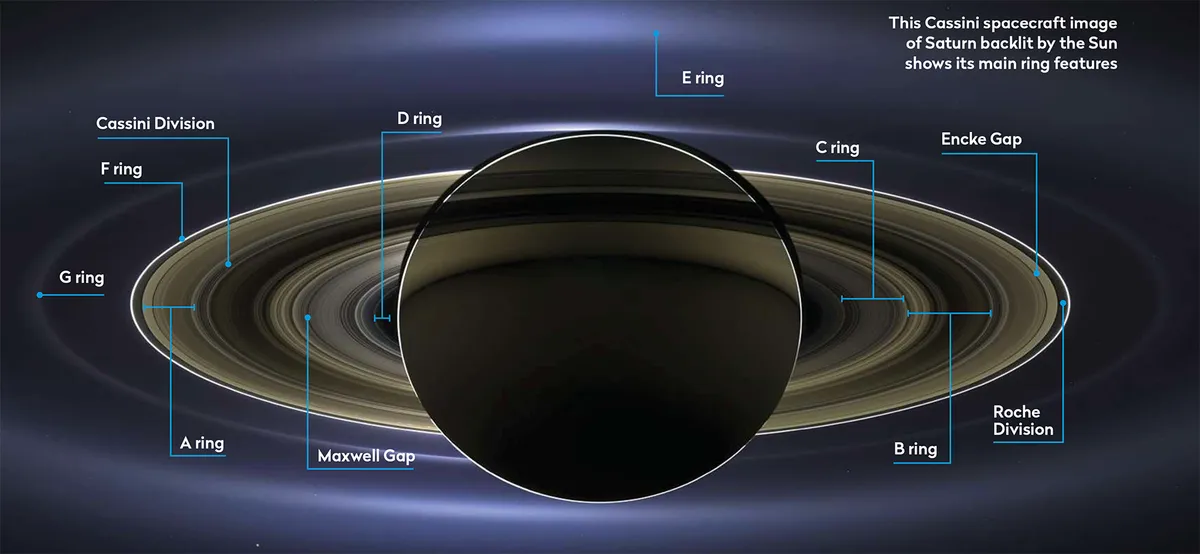
Saturn’s rings and widest gaps with names
Source: here
It is important to note that each ring orbits around Saturn at a different speed; the farther it is from Saturn, the slower it moves, as Kepler noticed with the Solar System’s planets and as Newton explained.
Atmosphere
Like Jupiter, Saturn has an extensive atmosphere, so it too is called a gas giant. Its atmosphere is about 96.3% hydrogen, 3.25% helium and 0.45% methane by volume with traces of other gases. The proportion of helium is considerably less in Saturn’s atmosphere than in Jupiter’s. The wind speeds are even faster than those in Jupiter’s atmosphere (up to 1800 km per hour compared with 200-400). Saturn is even colder than Jupiter, (-140 degrees Celsius at cloud top level compared with -110), which is not surprising, since Saturn is farther than Jupiter from the Sun. The outer cloud layer is composed of ammonia ice crystals, like the clouds around Jupiter. The wind, the cold and the ammonia clouds would make Saturn an undesirable place to visit.
Exploration
Muggles haven’t yet visited Saturn or any of its moons, but they have sent many unmanned missions there. Pioneer 11 flew by Saturn in 1979 and passed within 20,000 kilometres of the cloud tops. It took some low-resolution pictures of Saturn, its rings and a few of its moons. Voyager 1 flew by Saturn in 1980 and took better pictures of the moons, in particular Titan. Voyager 2 flew by in 1981 and discovered the Maxwell Gap within the C ring and the Keeler Gap in the A ring, as well as some moons near or within the rings.
Cassini entered orbit around Saturn on July 1, 2004. It released the Huygens probe, which landed on Titan on January 14, 2005 (see details about Titan in Year Two, Lesson Eight). Cassini continued to orbit Saturn until September 15, 2017, when it was made to crash into Saturn’s atmosphere to prevent it from accidentally landing on any of the moons, contaminating it with Earth-based microorganisms, organic compounds, and materials. Before its destruction, it discovered eight more moons, a new ring, and lightning, a thousand times as powerful as on Earth, in Saturn’s atmosphere. Another important discovery made by Cassini was that Enceladus, one of Saturn’s moons, is entirely covered with ice, giving that satellite the highest albedo of any body in the Solar System.
Angular Size, Apparent Magnitude, Albedo, and A.M.E.
And now it’s back to the numbers. Saturn’s angular size as seen from Earth ranges from 14.5 arcseconds to 20.1 arcseconds; these sizes do not include the rings. Its apparent magnitude as seen from Earth ranges from -0.55 to +1.17, but this range is due less to the distance of Saturn from the Earth and from the Sun than to the rings. The rings, being made mainly of water ice, reflect most of the light that falls on them, so they contribute a great deal to the planet’s apparent magnitude. Recall that Saturn’s equator – and its rings – are inclined at about 27 degrees from its orbit; that means that you can see Saturn at that max angle of 27 degrees from Earth - sometimes from its northern side and sometimes from its southern side. At those two times, they contribute the most to Saturn’s apparent brightness, which reaches its maximum if the planet is in opposition to the Sun. Twice during Saturn’s orbit around the Sun, the rings are seen edge-on from here, and at those times they contribute almost nothing to the planet’s apparent brightness. Without the rings, Saturn’s apparent magnitude would be about +0.7 on the average.
Voyager measured Saturn’s optical albedo at about 0.34, but Cassini revised that figure to 0.41. Since the tops of Saturn’s clouds are made of ammonia ice crystals rather than water, its magical albedo is the same as its optical albedo. As we learned last week, its A.M.E. is highest when Saturn is in conjunction with the Sun, so that’s when it contributes the most to the strengthening of Air Charms as well as to your ability to sense what others are feeling.
Concluding remarks
That concludes this leg of our imaginary exploration of the Solar System. The next one will take us to Uranus and Neptune. Meanwhile, there is the usual ten-question quiz to be answered. Class dismissed.
Astronomy 401 is about the solar system. Lesson 1, which is a historical overview about how the planets were discovered and named, has been published. So has Lesson 2, which is about Mercury. So has Lesson 3, which is about Venus. So has Lesson 4, which is about Mars. So has Lesson 5, which is about Jupiter. So has Lesson 6, which is about Saturn.
- ASTR-301
Enroll