

Lesson 5) Jupiter
4.5 Jupiter, the largest planet in the Solar System
As I mentioned last week, we are taking a different route to Jupiter from the one that Muggle missions have taken. Instead of moving away from the Sun while passing Jupiter, we will be at aphelion in our orbit - that is, at the farthest distance from the Sun - and moving in the opposite direction from Jupiter.
Right now we’re just close enough to Jupiter to see it about the same size as it was seen by the Hubble telescope.
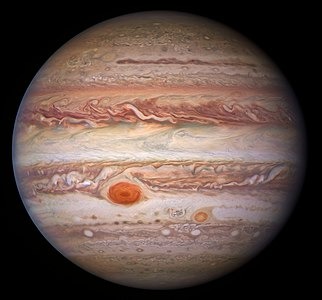
Jupiter as seen by the Hubble telescope
Source: here
Now we're close enough to see it the way it was seen by the Juno spacecraft in April 2018.
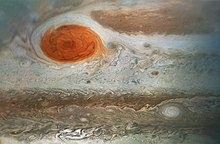
Jupiter as seen by the Juno spacecraft
Source: here
While we approach even closer, let’s discuss some facts about this gas giant: its motion, its physical characteristics, and what would be like to be on it.
Planetary Motion
Jupiter's average distance from the Sun is about 778.5 million kilometres from the Sun, or 5.2 times as far as that of Earth. It revolves around the Sun in just under 12 years and rotates around its axis in a bit less than ten hours, the fastest of all the planets. As a result, it bulges - that is, its equatorial diameter is greater than its polar one by about 6.5%, as one can see through an amateur telescope.
Physical Characteristics
Jupiter's average diameter (around 140,000 kilometres) is about 11 times that of Earth and about one tenth that of the Sun, making it the most massive of all the planets. Its mass is about 318 times that of Earth and less than one thousandth that of the Sun, but the planet’s gravity is strong enough that it and the Sun both revolve around a point that's a bit outside the Sun's photosphere. In other words, Jupiter is massive enough to noticeably influence the movement of the Sun!
Its mean density is about a quarter that of Earth. Jupiter’s core is made out of solid rock material consisting of iron and minerals, and the temperature there can be up to 50,000 degrees Celsius (about 90,000 degrees Fahrenheit).
What is it Like on Jupiter?
On Jupiter? There's no such thing as “on Jupiter”! Like all the outer planets, Jupiter doesn't have a surface, so there's no point in even mentioning its surface gravity. But it does have an atmosphere, which is made of about 89% hydrogen, 10% helium, and traces of other gases. The pressure exerted by the atmosphere and the temperature both increase as the distance from the centre of the planet decreases. At a distance where the pressure is the same as it is on Earth at sea level, the temperature is about -108 degrees Celsius, which is not surprising given how far Jupiter is from the Sun.
One would think that with so little energy coming from the Sun, there wouldn't be much wind, but the wind speed there, as on all the outer planets, is hundreds of kilometres per hour. It varies from one latitude to another, producing massive storms. The most famous of these is the Great Red Spot, which is even bigger than Earth! It is the largest storm in the Solar System, and it is an anticyclonic storm (a storm with a high-pressure center that rotates in the opposite direction to the usual low-pressure center storms). The Great Red Spot rotates counterclockwise once approximately every 6 days.
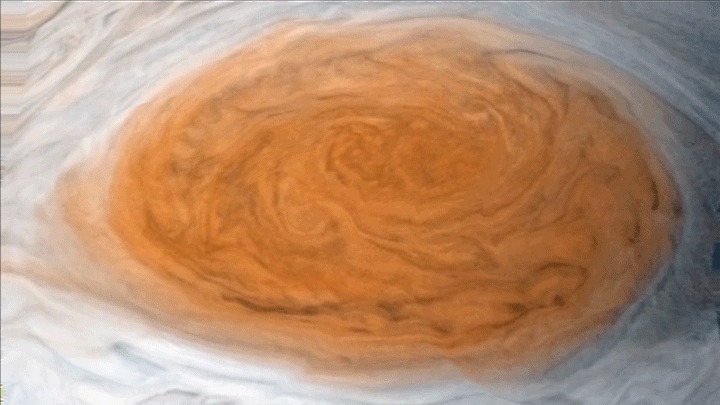
The Great Red Spot
Source: here
Now we're as close to Jupiter as we're going to get. We are moving at high speed, so we'll soon be moving away from the planet, which is a good thing because Jupiter emits deadly radiation. It is caused by the planet’s magnetic field, which is 14 times as strong as Earth's. Any manned mission to one of Jupiter's moons had better be based on the side that faces away from the planet!
This is what the planet’s inner structure looks like. To see an enlarged image of Jupiter's inner structure, its surface features, and its rings, you can see more in the source.
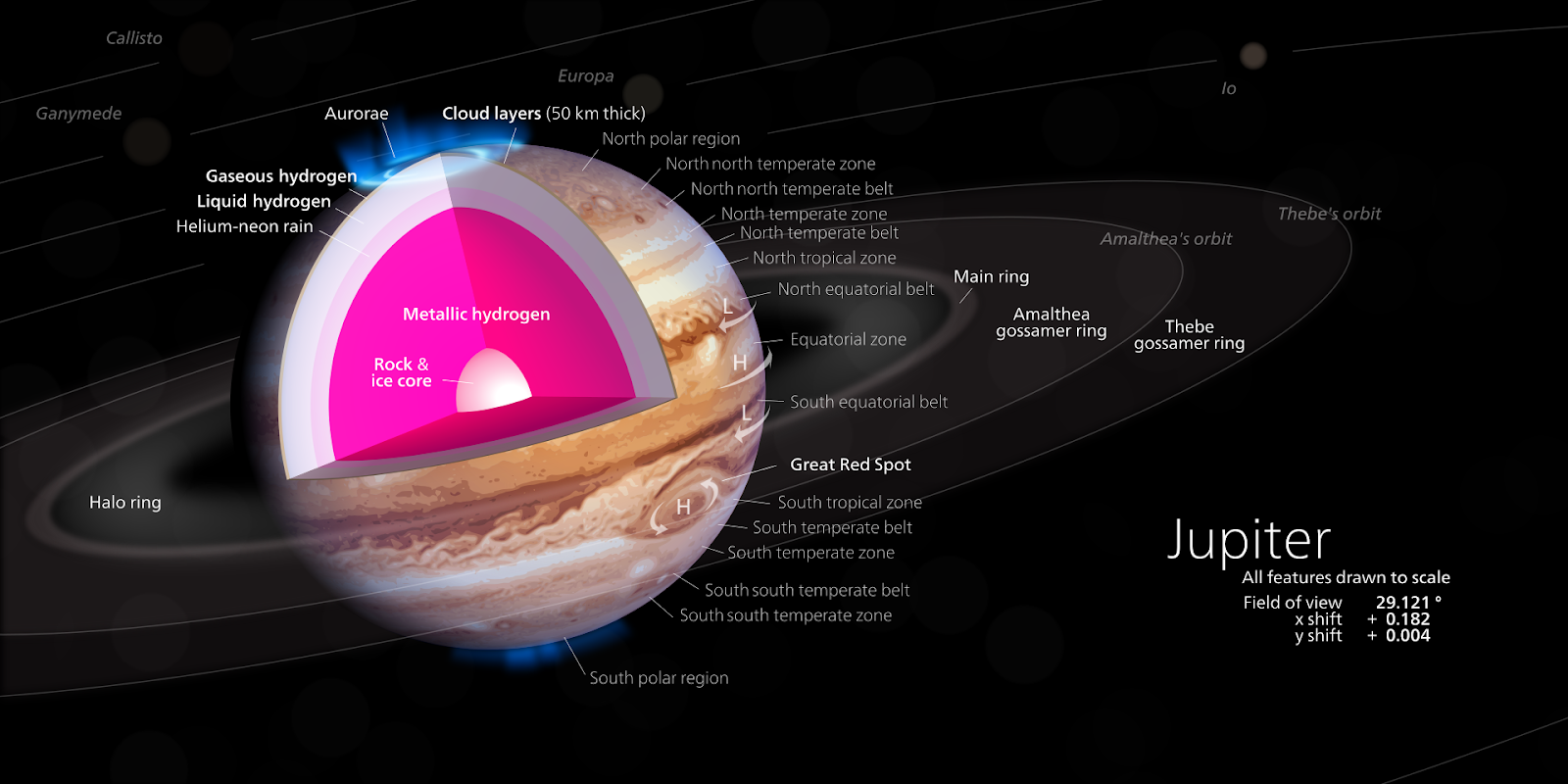
Jupiter’s inner structure, surface features, and rings
Source: here
We are now at perihelion, the closest distance to the Sun, with enough excess speed to make us move away from the Sun and towards Saturn, which we will visit next week. We will have got a massive gravity assist from Jupiter, much greater than any real spacecraft has ever got, but this imaginary one will enable us to give a simple explanation of how gravity assist works.
Relative to Jupiter, our speed is the same now that we’re moving away from it as it was when we were approaching it. But relative to the Sun, our speed now is much faster than it was because Jupiter’s speed is now added to ours rather than being subtracted from it. Here’s an analogous example to illustrate the point. Suppose you throw a perfectly elastic ball at the front of an approaching train. The ball’s speed relative to the train is the same after it bounces as it was before, but relative to the ground it’s much faster because the train’s speed is now added to it rather than subtracted from it.
Muggle Exploration of Jupiter
The first detailed observations of this planet were made in 1610 by Galileo Galilei with a small, homemade telescope. Years later, numerous spacecraft were sent to get more accurate information about this giant planet. The first spacecraft to voyage to Jupiter were Pioneer 10 and 11 in 1973 and 1974, respectively. They measured Jupiter's mass and polar and equatorial diameters. Voyagers 1 and 2, which passed by Jupiter in 1979, found that the Great Red Spot had shrunk since the earlier 20th century, discovered Jupiter's rings, and observed flashes of lightning on the planet's night side. Ulysses studied Jupiter's magnetosphere in 1992 and the Galileo spacecraft went into orbit around Jupiter in 1995. The latter observed the impact of the comet Shoemaker-Levy 9 when it collided with the planet. It released an atmospheric probe that studied the atmosphere until it was destroyed by extreme temperature and pressure. New Horizons flew by Jupiter in 2007 and took detailed pictures of the four Galilean moons (the planet’s four largest moons, first seen by Galileo). The last mission so far was Juno, which arrived at Jupiter in 2016 and is still orbiting the planet and sending back information. These spacecraft were all launched by NASA, but other space agencies are joining in, notably the European, Canadian, and Chinese. The current leg of our own imaginary mission has terminated now that we're as far from the planet as we were when you saw the first image, but don’t worry, we'll be back and exploring Saturn next week.
Jupiter's Magic
And now we come to the most interesting part of the lesson: the magic that Jupiter reflects to Earth and modifies. In Firenze's guest lecture, which he gave back in Year One, Lesson Four, he told us that Jupiter's reflected magic makes magical people more powerful, but it also has another effect. Maybe you’ve heard the word jovial before. The word comes from the French word meaning “pertaining to Jupiter” and is defined as jolly or cheerful. Jupiter's reflected magic not only makes you more powerful magically, but it also makes you jollier, possibly because being powerful does make one happy. Both of those effects are stronger the greater Jupiter's A.M.E. is.
When is Jupiter's A.M.E. the greatest? When Jupiter is in conjunction with the Sun (that is, when they appear close together in the sky), constructive interference doubles the planet's A.M.E. But does that mean that it's at its maximum then? Not necessarily! In conjunction with the Sun, Jupiter is farther from Earth in space than it is when it's in opposition to the Sun, as illustrated by this image.
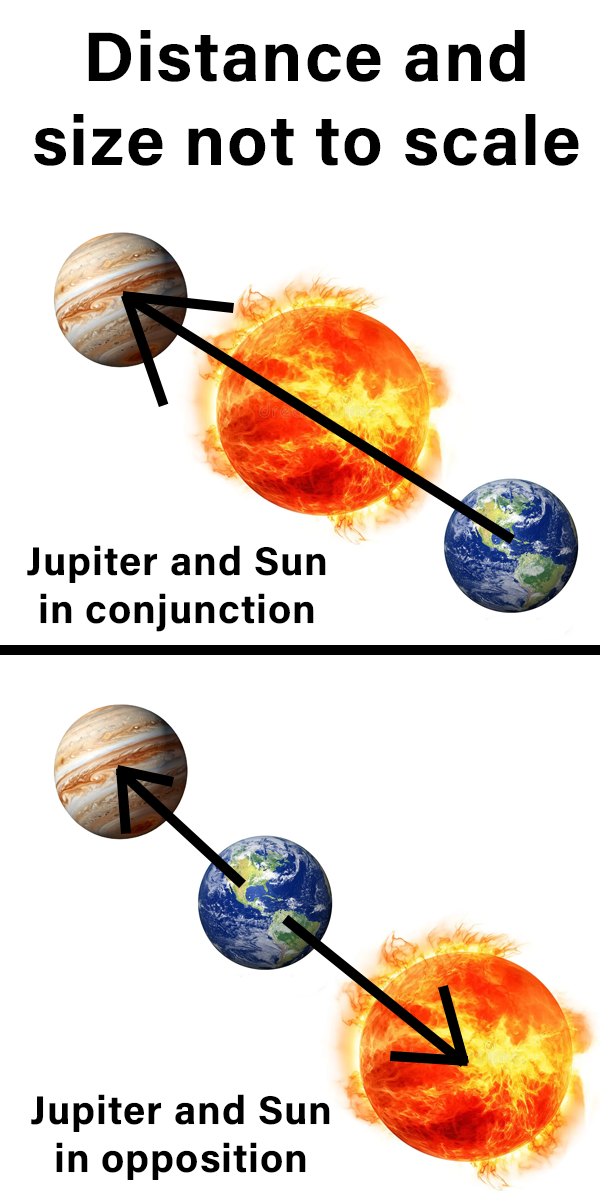
Jupiter and Sun in conjunction and in opposition
Source: here
As a result, its angular size is smaller. Is it small enough to make the planet's A.M.E. less during conjunction, despite the Sun's constructive interference, than during opposition? In a nutshell, if a planet is greater than about 5.83 times as far from the Sun as Earth, its A.M.E is greatest when in conjunction with the Sun; if it’s closer than that, its A.M.E. is greatest in opposition.
Jupiter is only 5.2 times as far from the Sun as Earth is, so its A.M.E. is greatest when it's in opposition, but only slightly. Mars is closer to the Sun than that, so its A.M.E. is by far the greatest when it's in opposition, (especially when it's in favourable opposition, which happens when it's at or near its perihelion). On the other hand, Saturn is 9.5 times as far from the Sun as Earth is, so its A.M.E. is greatest when it's in conjunction, as is the case for Uranus and Neptune. If you’re curious about the calculations behind this particular phenomenon, come to my office - oh, Albert is holding up a piece of parchment … and it contains the same calculations!
You may recall that in Year Two we mentioned another type of magic called elemental magic (named after the four elements discovered by the ancient Greeks – earth, water, air, and fire) and discussed how the Moon gives us water magic, which strengthens water charms. In Lesson Two this year, you learned that the rocky planets give us earth magic. Well, all the outer planets give us air magic and the Sun gives us fire magic. All those four types of magic are described in Year Four of the Charms course, Lessons Six through Nine, so you can look forward to those soon! The strength of each type of elemental magic depends upon the amount of magic that Earth gets from all sources. But as if the existence of two types of magic weren't complicated enough, it turns out that water magic and fire magic interfere destructively with each other, as do earth magic and air magic! When the Sun is above the horizon, you can't expect much help from the Moon in casting water charms. Similarly, you can’t expect much help from the outer planets in casting air charms on Earth, because all magic reflected by Earth is understandably very strong when you're on the planet – much stronger than when Earth is seen from another planet, as long as the Sun is shining on the ground you're standing on.
Closing remarks
And that concludes this evening's lesson. There will be a ten-question quiz on the material in this lesson and a twenty-question midterm on the material in Lessons One through Five, but no essay. Next week we'll be studying and viewing Saturn, and then there will be an essay assignment, but I think you're going to enjoy it. Class dismissed!
Astronomy 401 is about the solar system. Lesson 1, which is a historical overview about how the planets were discovered and named, has been published. So has Lesson 2, which is about Mercury. So has Lesson 3, which is about Venus. So has Lesson 4, which is about Mars. So has Lesson 5, which is about Jupiter. So has Lesson 6, which is about Saturn.
- ASTR-301
Enroll


